NoSQL vs SQL Explained for Beginners: A Complete Tech Guide
Building a new application comes with a lot of tough decisions, but choosing the right database is often the trickiest. You definitely aren’t alone if you’re feeling stuck. In fact, for countless developers and IT professionals, getting nosql vs sql explained for beginners is the first major hurdle when designing a backend architecture.
Whether you go with a relational (SQL) or non-relational (NoSQL) system will ultimately dictate how your data is stored, retrieved, and scaled. If you make the wrong choice early in development, you could easily end up facing severe performance bottlenecks, overly rigid data models, and incredibly expensive migrations later on.
Throughout this comprehensive technical guide, we’ll break down the core differences between these two foundational database structures. By the time you reach the end, you’ll know exactly which type best suits your project’s unique needs—setting you up for optimal performance and long-term scalability.
NoSQL vs SQL Explained for Beginners: Why the Dilemma Happens
To really understand nosql vs sql explained for beginners, we first need to look at how each system organizes information under the hood. This common dilemma pops up mainly because today’s modern applications have to process massive volumes of both structured and unstructured data.
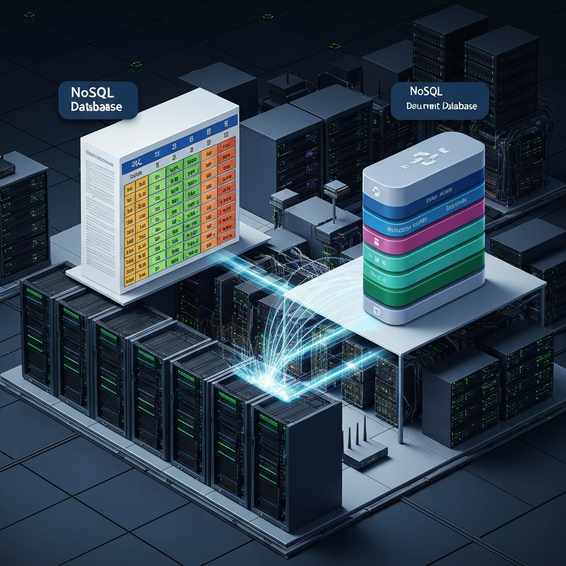
On one side, you have SQL databases like MySQL and PostgreSQL, which are highly structured. They store data using rigid, table-based models with predefined schemas. Because every single row must follow the exact same column layout, this approach is absolutely perfect for running complex reports and maintaining strict data integrity.
On the flip side, NoSQL databases such as MongoDB and Cassandra thrive on flexibility. Instead of tables, they store information using non-relational formats—think JSON documents, key-value pairs, or even graph structures. Thanks to this dynamic design, developers can easily introduce new data types on the fly without having to rewrite the entire database schema.
When it comes to reliability, SQL databases natively enforce what are known as ACID properties: Atomicity, Consistency, Isolation, and Durability. This standard guarantees that every single transaction processes safely. Should a server crash happen mid-transaction, the database simply rolls back the incomplete changes, saving you from catastrophic data corruption.
NoSQL databases, by contrast, generally lean on the BASE model: Basically Available, Soft state, and Eventual consistency. Rather than insisting on immediate data perfection across the board, they prioritize keeping the system online and partitioned effectively. While it is a tradeoff, it makes NoSQL setups incredibly resilient when facing server outages.
Trouble usually brews when developers try to force a rigid SQL structure onto fast-changing, unstructured data. It also happens when they attempt to run complex, multi-table transactions through a NoSQL document store. Ultimately, choosing the wrong foundational model is a fast track to accumulating massive technical debt.
Quick Fixes / Basic Solutions for Database Selection
If you want a straightforward way to solve this database dilemma, having a simple decision matrix helps immensely. Here are a few actionable, basic rules of thumb to guide you in the right direction.
- Choose SQL for Structured Data: If your app handles highly organized records—like financial transactions or tightly managed e-commerce inventory—a relational database is generally your best bet. SQL gives you strict compliance and peace of mind when it comes to transactional safety.
- Choose NoSQL for Rapid Prototyping: Building a minimum viable product (MVP) with a constantly shifting data model? A non-relational database provides the flexibility needed to pivot your application quickly without the headache of writing complex migrations.
- Use SQL for Complex Queries: Any application that relies heavily on deep reporting, multi-table JOINs, and intricate business logic naturally pairs perfectly with a robust SQL engine like PostgreSQL.
- Use NoSQL for High-Velocity Data: When you are dealing with a firehose of information—such as real-time analytics, rapid social media feeds, or continuous IoT sensor data—NoSQL shines thanks to its ability to ingest data incredibly fast.
Advanced Solutions: A Developer and IT Perspective
Once you move into enterprise-level applications, picking between SQL and NoSQL is rarely just a simple coin toss. Advanced IT teams have to evaluate their options through a much wider lens, looking closely at infrastructure scalability, clustering capabilities, and the broader cloud architecture.
Generally speaking, SQL databases scale vertically. As your user base grows, you have to continually beef up the CPU, RAM, or storage capacity of a single monolithic server. Even though modern cloud providers have made vertical scaling much easier, you will eventually hit a hard physical limit on just how powerful a single node can get.
NoSQL databases, however, were designed to scale horizontally. Through a process known as sharding, you can easily distribute your database workload across multiple servers. When you need more processing power, you just add more commodity servers to the cluster. This horizontal expansion is the exact reason why global tech giants rely heavily on NoSQL for massive, distributed operations.
Scaling aside, DevOps engineers also have to think about high availability and disaster recovery. Successfully replicating SQL databases usually requires setting up complex primary-replica systems complete with asynchronous failovers. Managing that correctly takes deep technical expertise, especially if you want to prevent frustrating downtime during unexpected traffic spikes.
Interestingly, a lot of modern engineering teams bypass this either-or dilemma entirely by embracing a Polyglot Persistence architecture. This advanced approach involves running both SQL and NoSQL databases side-by-side within the exact same ecosystem, allowing the application to leverage the unique strengths of each technology where it makes the most sense.
Best Practices for Database Optimization
Picking the perfect database is really just step one in your development journey. If you want to guarantee long-term performance and keep your codebase maintainable, sticking to industry-standard best practices is an absolute must.
- Define Your Data Model First: Don’t just spin up a new database blindly. Take the time to comprehensively map out exactly how your application will query the data, optimizing for retrieval speed if your operations are going to be read-heavy.
- Prioritize Security Measures: Regardless of whether you land on SQL or NoSQL, securing your data against malicious injection attacks is critical. Always use parameterized queries in SQL environments, and enforce strict role-based access control (RBAC) across the board.
- Implement Automated Backups: Catastrophic data loss is every IT team’s worst nightmare. Take advantage of built-in cloud automation tools to schedule daily snapshots and set up point-in-time recovery for all of your production instances.
- Monitor Query Performance: Keep a close eye on your application to catch slow queries early. For SQL, that means using proper indexing strategies to accelerate table lookups. In NoSQL, aim to flatten your document structures so you aren’t bogged down by excessively deep, nested arrays.
Recommended Tools and Cloud Resources
Are you ready to deploy your first high-performance database? Here are a few of the top cloud database providers and self-hosted tools that developers around the world consistently recommend.
- DigitalOcean Managed Databases: This is a wonderfully developer-friendly platform for spinning up highly available PostgreSQL and MySQL clusters. It’s an excellent choice for beginners who want the power of SQL without the headache of managing backend server infrastructure.
- MongoDB Atlas: Widely considered the premier cloud-native service for hosting MongoDB environments. It effortlessly takes care of scaling, automated backups, and advanced security features right out of the box.
- Amazon RDS (Relational Database Service): A true enterprise-grade managed solution for AWS users. RDS fully automates the tedious administrative chores like hardware provisioning, environment setup, and routine security patching.
- Redis: Known for being incredibly fast, this open-source, in-memory data structure store is frequently deployed right alongside a primary SQL database to handle rapid session caching and real-time application analytics.
If you happen to prefer doing things locally for development and testing, you can instantly spin up any of these robust databases using Docker containers right inside your personal HomeLab environment.
FAQ Section
Is NoSQL faster than SQL?
Not necessarily. Database performance depends entirely on your specific context and use case. While NoSQL is generally faster at simple read/write operations and ingesting massive volumes of unstructured data, SQL pulls ahead when you need to execute highly optimized, complex queries that involve joining multiple tables together.
Which database is easier for beginners to learn?
Many find NoSQL databases like MongoDB a bit easier to grasp right out of the gate. This is because they use JSON-like documents that map very cleanly to objects in modern programming languages like JavaScript. That being said, learning core SQL syntax is still a non-negotiable, essential skill that every software developer will eventually need to master.
Can SQL and NoSQL databases be used together?
Absolutely. As we mentioned earlier, this architectural pattern is known as Polyglot Persistence. In fact, large-scale enterprise applications do this all the time. A very common industry setup involves relying on PostgreSQL to handle critical financial transactions while offloading high-volume system logs to a NoSQL database like Cassandra.
Does NoSQL completely lack a schema?
Even though NoSQL is heavily marketed as being completely “schema-less,” a more accurate description is that it features a flexible or dynamic schema. Rather than having strict rules enforced by the backend database engine itself, the data structure is mostly dictated by how your application code interacts with it.
Conclusion
Choosing between these two vastly different database architectures doesn’t have to feel like an overwhelming guessing game. By having the topic of nosql vs sql explained for beginners fully demystified, you are now equipped to make highly informed, strategic decisions about your next tech stack.
At the end of the day, if your application relies heavily on strict data integrity, complex transactions, and rigid schemas, a traditional relational SQL database remains the clear winner. On the flip side, if your latest project needs massive horizontal scalability, room for rapid iteration, and highly flexible data models, a non-relational NoSQL solution is going to serve you much better.
The best advice is to start small. Thoroughly prototype your data models locally, and don’t be afraid to lean on managed cloud databases to simplify your backend setup. By carefully matching the right technical tool to the problem at hand, you’ll be well on your way to building robust, highly performant applications that are ready to scale.
About the Author